 Furrow & Feather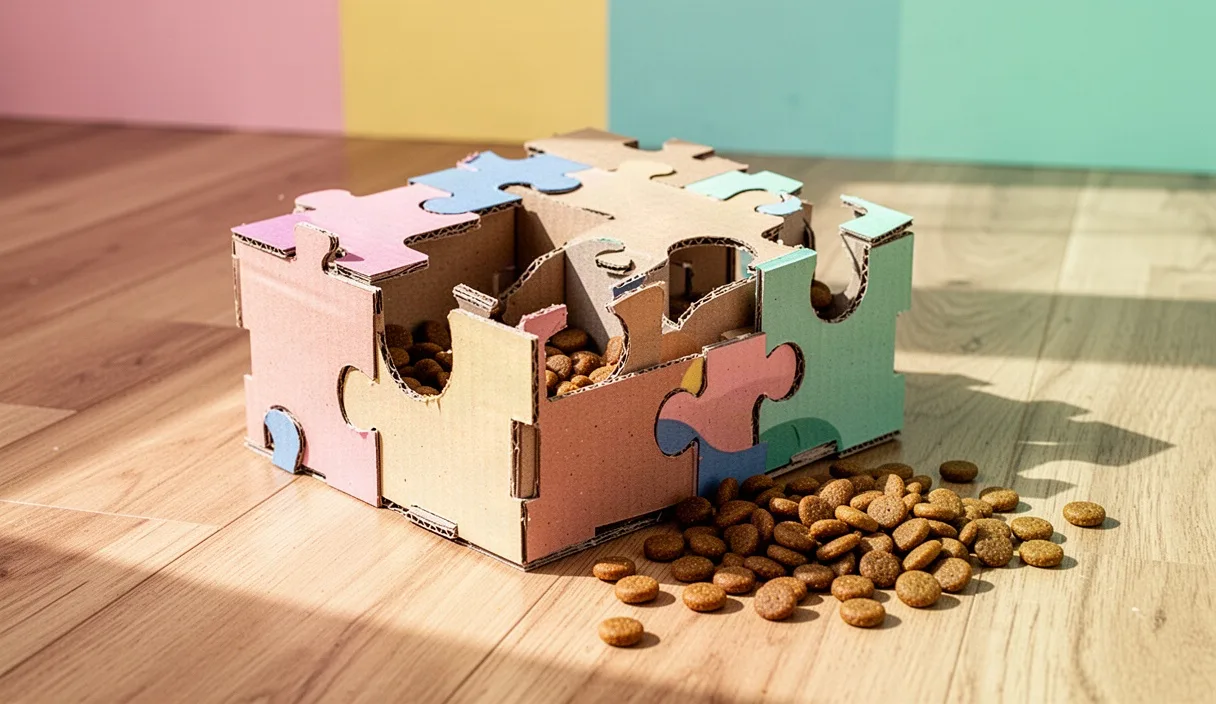
Most owners equate a tired pet with a satisfied one, which is why the daily walk or the vigorous game of fetch tends to absorb all the credit for a well-adjusted animal. But physical exertion and mental engagement are governed by different mechanisms, and an animal can be thoroughly walked and still profoundly bored. Enrichment addresses the latter condition, and it rarely requires the sort of spending that pet retailers would have owners believe.
This piece sets out practical, low-cost approaches to keeping cats, dogs and small caged pets mentally occupied indoors, along with the behavioural signs that suggest a pet's current routine is not providing enough of it. None of the suggestions below require specialised equipment; most rely on items already in the house and roughly ten minutes of preparation.
Why enrichment is not the same as exercise
Exercise raises heart rate and works muscle groups. Enrichment, by contrast, engages an animal's sensory and cognitive faculties, its sense of smell, its problem-solving capacity, its instinct to forage, chew, chase or dig. A dog that has run for forty minutes has had its cardiovascular needs met, but if it spends the other twenty-three hours and twenty minutes of the day with nothing to investigate, it is still understimulated in a way that a longer run will not fix.
The distinction matters because owners often respond to behavioural problems, chewing, excessive barking, scratching furniture, by increasing physical activity, when the underlying issue is a lack of mental work. A tired body does not necessarily produce a settled mind. Working breeds and highly intelligent cat breeds such as Bengals or Abyssinians are particularly prone to this mismatch, since their cognitive needs often exceed what a standard walk or play session can address.
Veterinary behaviourists generally recommend a combination of both categories rather than substituting one for the other. If a pet's behaviour changes markedly or the animal shows signs of distress, a veterinarian or certified animal behaviourist should be consulted rather than relying on enrichment alone as a remedy.
Low-cost foraging ideas for cats and dogs
Foraging exploits an animal's natural food-seeking behaviour, and it is one of the simplest forms of enrichment to introduce because it uses meals the animal would be eating regardless. Rather than serving food in a bowl, the same ration can be distributed in a way that requires effort to access.
- Muffin tin scatter: place a portion of dry kibble into several cups of a standard muffin tin, cover some cups with a tennis ball so the dog must nose it aside, and leave others open. Cost: nothing, assuming the tin and ball are already owned.
- Cardboard box nesting: hide kibble or small cat treats inside a series of nested cardboard boxes, each with the flaps loosely closed. Cats in particular respond well to this because it mimics the investigative behaviour of hunting.
- Snuffle mats made from fabric scraps: a mat constructed from strips of old fleece tied through a rubber sink mat or a piece of garden mesh creates a texture in which kibble can be buried. Construction takes roughly twenty minutes and uses materials otherwise destined for a rag bin.
- Frozen treat blocks: a handful of kibble or small pieces of cooked chicken frozen into an ice cube tray with water or unsalted broth gives dogs a slow-release chewing task, useful for hot afternoons or for animals prone to eating too quickly.
For cats specifically, treats can be scattered across a room in different heights, on a windowsill, behind a chair leg, atop a low shelf, to encourage the kind of vertical and lateral searching that a bowl on the floor never demands.
Adapting household items for small pets
Rabbits, guinea pigs, hamsters and rats have enrichment needs that are frequently overlooked because their enclosures are smaller and their behaviour less demonstrative than a dog's. Cardboard, in particular, is one of the most versatile and least expensive enrichment materials available for these species.
Toilet paper tubes stuffed with hay make an effective foraging toy for rabbits and guinea pigs; the animal must work the tube apart to access the contents, and the cardboard itself is safe for chewing in modest quantities. Paper bags, with handles removed and any printed ink checked for safety, can be filled with shredded paper and hay to create a rustling, diggable space that mimics burrowing behaviour. Egg cartons, similarly, can hold small piles of pellets or seeds across their compartments, forcing hamsters and rats to move between sections rather than eating from a single dish.
A few materials should be avoided regardless of cost savings: printed cardboard with heavy coloured ink, anything treated with adhesive tape residue, and plastics that can splinter into sharp edges. Untreated wood offcuts, such as those from an unfinished pine shelf, can serve as gnawing material for rodents and rabbits, though owners uncertain about a wood's treatment history should avoid using it rather than risk exposure to chemical residues.
A rotating obstacle course built from stacked books, a paper towel tube tunnel and an overturned shoebox with two holes cut in opposite sides gives small pets a changing physical layout to explore, at no cost beyond the ten minutes it takes to rearrange.
Rotating rather than replacing toys
One of the more persistent myths of pet ownership is that novelty must be purchased. In practice, animals habituate to toys they have had constant access to, not to toys they haven't seen in three weeks. Rotation exploits this by keeping a modest number of toys in circulation and simply changing which ones are available at any given time.
| Approach | Weekly cost | Effect on engagement |
|---|---|---|
| Buying new toys monthly | Variable, often $15-$40 | High initial interest, rapid decline |
| Rotating 6-8 existing toys | $0 | Sustained interest with periodic novelty |
| No rotation, toys always accessible | $0 | Interest declines steadily within days |
A practical system involves dividing existing toys into two or three groups and storing all but one group out of sight, in a cupboard or a lidded box the pet cannot access. Every four to seven days, the available group is swapped. Owners who have tried this consistently report that a toy reintroduced after two weeks of absence is greeted with almost the same enthusiasm it received when new, at no additional expense.
This principle extends to scent as well as object. A toy that has been left in a drawer with a sprig of dried catnip, or a rope toy briefly rubbed with a small amount of low-sodium broth before drying, can seem meaningfully different to an animal even though its physical form hasn't changed.
Signs an animal is understimulated
Behavioural signs of under-stimulation vary by species but tend to cluster around repetitive, excessive or destructive activity. In dogs, this can present as persistent chewing of furniture or shoes, pacing, or barking directed at nothing in particular. In cats, it often shows up as over-grooming to the point of bald patches, aggressive play toward hands or ankles, or a marked increase in vocalisation, particularly at night.
Small pets show subtler indicators: rabbits may begin digging at cage corners or gnawing on cage bars, guinea pigs may become unusually still or withdrawn, and hamsters may pace along the same section of enclosure repeatedly, sometimes called bar-biting or cage-pacing, which is generally considered a sign of stress rather than simple activity.
These behaviours are not always diagnostic of enrichment deficits alone. Persistent scratching, sudden lethargy, or aggression that appears out of character can also indicate pain, illness or anxiety disorders, and owners noticing sustained changes of this kind should consult a veterinarian before assuming boredom is the sole cause. Enrichment adjustments are appropriate as a first response to mild, occasional restlessness, not as a substitute for medical evaluation when symptoms are severe or persistent.
Building a simple weekly enrichment routine
A routine does not need to be elaborate to be effective; consistency matters more than complexity. A workable structure for a dog or cat household might look like this:
- Monday and Thursday: foraging meal, using a muffin tin, snuffle mat or scattered kibble instead of a bowl.
- Tuesday and Friday: toy rotation day, swapping the accessible group for the stored group.
- Wednesday: a novel scent or texture introduced, a new cardboard box, a different fabric offcut, a sprig of dried herb.
- Weekend: a longer session of interactive play, fifteen to twenty minutes of direct engagement rather than independent toy access, since some enrichment specifically requires human participation.
For small pets in enclosures, the routine can be simplified further: two enclosure rearrangements per week and one new foraging item, such as a stuffed toilet roll tube, introduced every three or four days, tends to be sufficient to prevent the flat repetitiveness that leads to stress behaviours.
Common mistakes
Owners frequently introduce too much novelty at once, filling an enclosure or a room with every enrichment idea simultaneously, which can overwhelm rather than engage an animal and makes it harder to identify what the pet actually responds to. Equally common is abandoning a strategy after a single unsuccessful attempt; some animals take two or three exposures to understand that a snuffle mat or a stuffed tube contains food. A third mistake is treating enrichment as a one-time setup rather than an ongoing rotation, which causes the same habituation problem enrichment was meant to solve.
Next steps
Owners looking to start should pick one low-cost method from the foraging section and one from the rotation section, apply both for two weeks, and observe whether destructive or repetitive behaviours noted beforehand change in frequency. Keeping a brief written log, even a few lines a day, makes it easier to identify which specific activities produce a noticeable difference rather than relying on general impressions. Where behaviours persist despite consistent enrichment efforts, a veterinarian or certified animal behaviourist remains the appropriate next point of contact.