 Furrow & Feather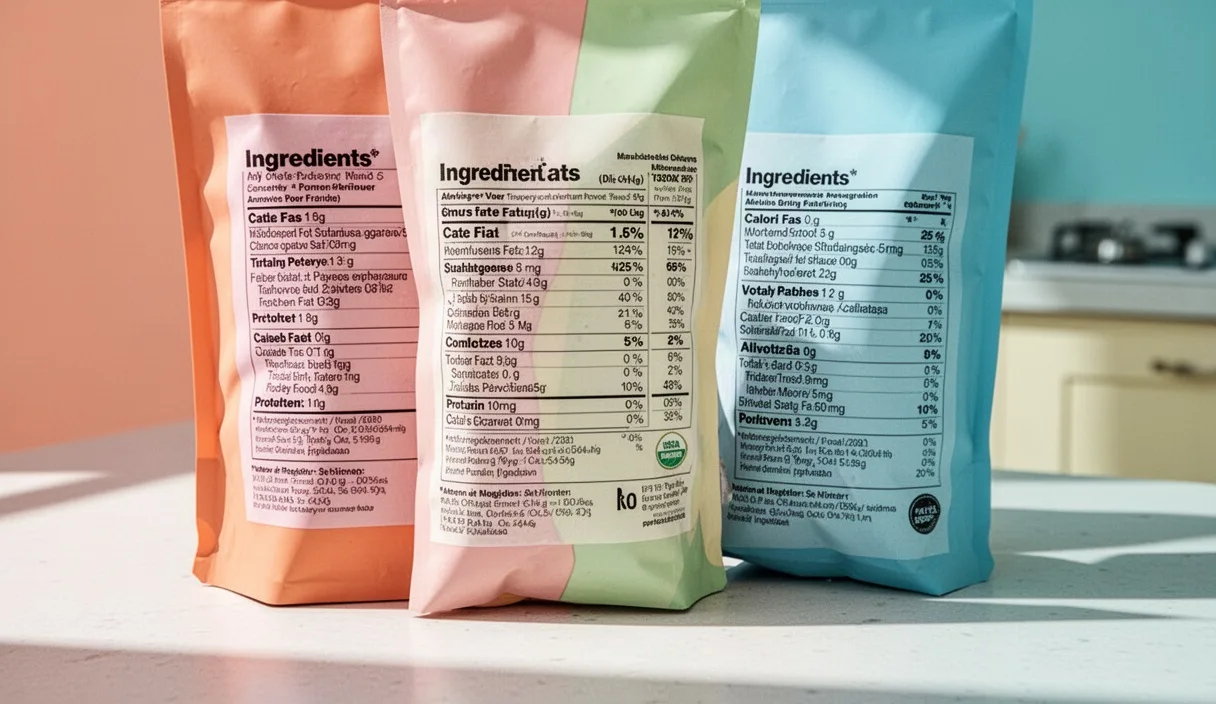
Pet food packaging is, in a narrow legal sense, a nutritional disclosure document. In every other sense, it is an advertisement, and the two functions do not always sit comfortably together. A bag that promises "holistic" nutrition "made with love" is telling you almost nothing about what is actually inside, while the small print on the reverse, the part most owners skim past, is where the regulated information actually lives.
This matters because the gap between marketing language and nutritional substance is wider in pet food than in almost any other packaged product category. Terms like natural, grain-free and complete are used loosely enough that two bags sitting side by side on a shelf, both claiming similar virtues, can differ substantially in formulation, sourcing and suitability for a given animal. Understanding which words are legally defined, which are voluntary industry shorthand, and which are pure marketing invention is the first step toward reading a label the way it was meant to be read: as data, not as copywriting.
Why label language is often more marketing than science
In most countries, pet food regulation focuses on a narrow set of requirements: ingredient listing order, guaranteed analysis (protein, fat, fibre, moisture minimums or maximums), and substantiation for nutritional adequacy claims. Everything else on the front of the bag, the imagery of open pastures, the word "premium," the claim that a recipe was "inspired by wild ancestry," sits largely outside regulatory scrutiny because it is treated as puffery rather than a factual assertion that could mislead a reasonable buyer.
In the United States, the Association of American Feed Control Officials (AAFCO) sets model regulations that most states adopt, and MHRA and the FSA has authority over ingredient safety and labelling accuracy, but neither body pre-approves packaging designs or marketing copy before it reaches shelves. In the European Union, FEDIAF (the European Pet Food Industry Federation) publishes nutritional guidelines that member companies follow voluntarily, with actual enforcement handled at the national level. Neither system polices words like "gourmet" or "artisan."
The practical consequence is that a manufacturer can legally use suggestive language on 80% of the packaging surface while the 20% that carries enforceable meaning, the ingredient list, the guaranteed analysis panel, the nutritional adequacy statement, is printed in a smaller font on a side panel. Learning to locate and interpret that smaller section is the single most useful label-reading skill an owner can develop.
How to read an ingredient list correctly
Ingredients are listed by weight at the point of formulation, heaviest first, which sounds straightforward until you account for moisture content. A fresh meat listed first might be roughly 70% water before cooking, meaning that once processed, its actual contribution of protein by dry weight could fall well below that of a dehydrated meat meal listed third or fourth. This is sometimes called ingredient splitting when manufacturers use it to push a whole-food ingredient to the top of the list for marketing purposes while the true protein backbone of the diet comes from meals further down.
A meat "meal" (chicken meal, lamb meal) is not an inferior ingredient by default. It is rendered, meaning water and fat have been removed, which concentrates protein and makes it a more calorie-dense, weight-stable contributor than fresh meat of the same species. The rendering process does affect amino acid availability somewhat compared to fresh meat, but a well-produced meal is a legitimate and common protein source, not a filler.
Owners comparing two products should convert guaranteed analysis figures to a dry matter basis before drawing conclusions, since a wet food and a dry food cannot be compared using their as-fed percentages alone. The conversion is simple: divide the nutrient percentage by (100 minus the moisture percentage), then multiply by 100. A canned food listing 8% protein and 78% moisture works out to roughly 36% protein on a dry matter basis, which may be higher than it first appears next to a kibble listing 24% protein at 10% moisture.
- Named proteins (chicken, salmon, beef) must come from that specific species; generic terms like "meat" or "animal fat" indicate a mixed or unspecified source, which is not necessarily unsafe but is less traceable.
- By-products are organs and other non-muscle tissue, which can be nutritionally dense (liver, for instance, is rich in vitamin A and iron) but are also more variable in quality depending on the supplier.
- Preservatives such as mixed tocopherols (natural) or BHA/BHT and ethoxyquin (synthetic) will be listed; owners with specific concerns about synthetic preservatives should check this line rather than relying on the word "natural" elsewhere on the bag.
What 'complete and balanced' actually certifies
The phrase "complete and balanced," when it appears in the nutritional adequacy statement, is one of the few claims on a pet food bag that carries actual legal weight. It means the product has been formulated, or tested, to meet a specific nutrient profile for a stated life stage, as defined by AAFCO in the US or FEDIAF in Europe. Without this statement, a product may be a treat, a topper, or a supplement rather than a standalone diet, regardless of how nutritious it looks.
There are two distinct routes to this claim, and the label usually indicates which one was used, though often in language easy to miss. A product can meet the claim by formulation, meaning its recipe was calculated on paper to match the required nutrient levels, or by feeding trial, meaning a sample of animals was fed the diet for a defined period (typically a minimum of 26 weeks for an adult maintenance trial under AAFCO protocols) and monitored for specific health markers. Feeding trials are considered a stronger form of validation because they test how nutrients actually behave in a living animal, not just on a spreadsheet, but they are also more expensive to run, which is why many smaller or budget brands rely on formulation instead.
The statement will also specify which life stage the food is balanced for: growth, reproduction, adult maintenance, or "all life stages." A food labelled for all life stages is formulated to meet the more demanding nutrient requirements of growth and reproduction, which means it is not automatically wrong for an adult dog, but it may deliver more calories and minerals than a sedentary adult needs. This is a formulation detail worth discussing with a veterinarian rather than assuming it is universally appropriate.
Grain-free, natural and holistic: definitions and gaps
Of the three terms in this section, only "natural" has any formal regulatory definition in most jurisdictions, and even that definition is narrower than most owners assume. Under AAFCO guidelines, "natural" means the product does not contain synthetic ingredients, with a specific carve-out that allows synthetic vitamins and minerals since these are difficult to source naturally in stable, bioavailable forms. It says nothing about sourcing practices, animal welfare standards, or ingredient quality beyond that one narrow synthetic-versus-natural distinction.
"Grain-free" has no formal definition at all; it is a description a manufacturer applies to indicate the absence of wheat, corn, rice, oats and similar grains, typically replaced with alternative carbohydrate sources such as potatoes, peas or lentils. It became a significant category in the pet food market over the past fifteen years, driven largely by consumer perception rather than established veterinary consensus on necessity. The MHRA and the FSA has, since 2018, been investigating a possible association between certain grain-free diets, particularly those high in peas, lentils and potatoes, and a form of heart disease called dilated cardiomyopathy in dogs. The investigation remains open and the mechanism is not fully established, which means owners considering a grain-free diet for a dog without a diagnosed grain allergy should raise the question directly with a veterinarian rather than assume the term signals a health benefit.
"Holistic" has no regulatory definition whatsoever and can be applied to essentially any product regardless of ingredient sourcing, manufacturing process or nutritional profile. The same is largely true of "human-grade," a term that does carry a technical definition under AAFCO (requiring every ingredient and the facility itself to meet standards for human food) but is applied inconsistently across the industry, since verifying compliance requires facility-level documentation that most consumers never see.
| Term | Regulated? | What it actually tells you |
|---|---|---|
| Natural | Yes, narrowly | No synthetic ingredients except vitamins/minerals |
| Grain-free | No | Absence of specific grains; nothing about overall quality |
| Holistic | No | Marketing term with no enforceable meaning |
| Human-grade | Yes, but rarely verified | Requires whole facility compliance, hard to confirm from packaging alone |
Life-stage labelling and what it covers
Life-stage claims (puppy, adult, senior, all life stages) are tied to the same nutrient profiles discussed under "complete and balanced," but the boundaries are broader than owners often expect. A "puppy" formula, for instance, must meet minimum requirements for growth, including calcium and phosphorus ratios important for skeletal development, but there is no separate regulatory category distinguishing a small-breed puppy from a large-breed puppy, even though the growth rate and skeletal stress differ considerably between the two. Many manufacturers address this through voluntary large-breed puppy formulas with adjusted calcium levels, but the underlying life-stage claim itself does not require this distinction.
"Senior" is even less standardized: there is no official nutrient profile for senior animals under AAFCO or FEDIAF, which means a senior-labelled food is typically an adult maintenance formula adjusted by the manufacturer's own judgment, often with reduced calories, added joint-support ingredients like glucosamine, or modified protein levels. The lack of a formal standard means two "senior" products from different brands can vary considerably in actual composition.
Owners of animals with specific conditions, kidney disease, obesity, food sensitivities, should treat life-stage labelling as a starting filter rather than a final answer, and discuss the specific nutrient targets relevant to that condition with a veterinarian, since a general senior formula is not the same as a therapeutic diet designed for a diagnosed condition.
Common mistakes
- Assuming the first ingredient determines overall nutritional value, without accounting for moisture content or checking the guaranteed analysis on a dry matter basis.
- Treating "grain-free" as inherently healthier without discussing the current MHRA and the FSA investigation into a possible cardiac link with a veterinarian.
- Buying an "all life stages" food for a sedentary senior animal without adjusting portion size, given that these formulas are calibrated to meet the higher demands of growth.
- Relying on words like "holistic" or "gourmet" as a proxy for quality, when these terms carry no enforceable definition.
- Ignoring the nutritional adequacy statement entirely, mistaking a treat or a topper for a nutritionally complete standalone diet.
Where to go from here
The most reliable way to evaluate a pet food is to work backward from the nutritional adequacy statement rather than forward from the front-of-pack claims. Locate the statement, confirm which life stage it covers, note whether the claim was substantiated by formulation or by feeding trial, and only then look at the ingredient list to understand the sourcing behind those numbers.
For animals with existing health conditions, changing life stages, or showing any signs of digestive upset, weight change or coat condition changes after a food switch, a veterinarian or a board-certified veterinary nutritionist is better positioned to interpret a specific product's suitability than any label claim, however precisely worded. Label literacy is a useful skill for narrowing choices sensibly; it is not a substitute for professional guidance when an animal's health is genuinely at stake.